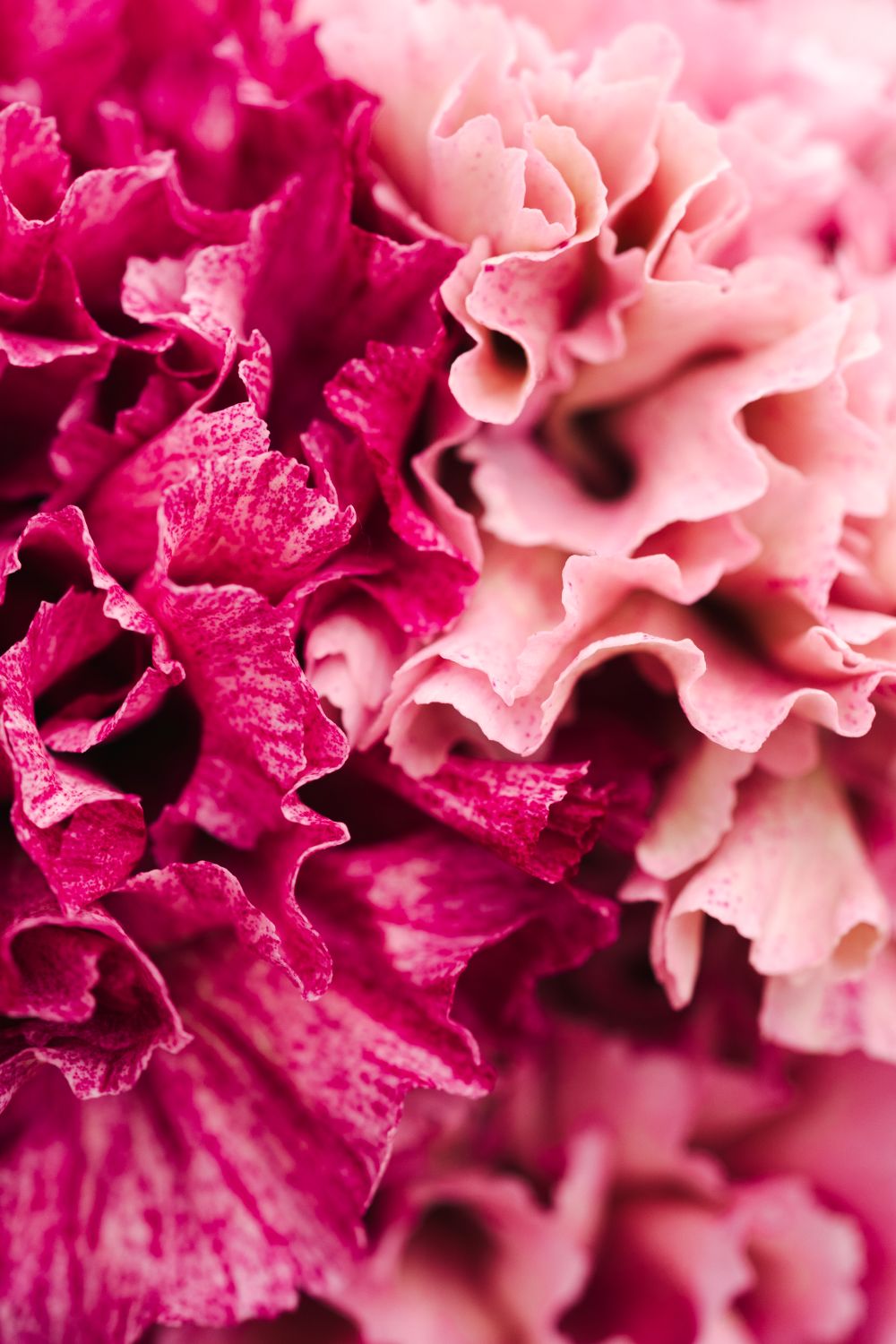




Carnation (Dianthus)
For a long time, the carnation was seen as old-fashioned – the dusty little flower on your grandparents’ table or at funerals. Yet for years now, this colourful charmer has been making an impressive comeback in modern bouquets, and not without reason. The carnation, botanically Dianthus caryophyllus, belongs to the carnation family (Caryophyllaceae) and has its roots in the Mediterranean region, although it grows naturally as far as Europe and Asia. You may also know it as the ‘flower of the gods’, a title that comes straight from its Greek name: dios (god) and anthos (flower).
Whether you choose the classic single-flower carnation with one lush bloom per stem, or the full spray carnation with several smaller flowers on the same branch: in a bouquet it combines effortlessly with almost anything, strong enough to take the lead role itself, soft enough to shine alongside roses or gypsophila. Our carnations and spray carnations come from Divine Flowers, a partnership of two Dutch carnation growers who have fully dedicated themselves to this craft since 2017. With almost 140 exclusive varieties in house and a fixed post-harvest treatment that extends vase life, our growers know exactly how to give every stem the best start on its way to your vase.
Did you know..
During the Second World War, Prince Bernhard almost always wore a white carnation on his lapel. The resistance adopted this habit as a secret sign of recognition against the German occupiers, which turned the flower into a symbol of resistance. Today the white carnation still carries that meaning – it stands for appreciation and respect and is traditionally worn on the Dutch Veterans Day.
Carnation (Dianthus) care
With a few simple habits you can keep a bouquet of carnations, whether it’s the sturdy single-flower variety or an exuberant spray carnation, in top shape for weeks. The care tips in short:
- Cut the stems at an angle with a sharp knife before placing them in the vase.
- Refresh the water every two to four days and re-cut the stems each time.
- Place the vase somewhere cool, out of direct sunlight and not next to a fruit bowl.
- Note: carnations are mildly toxic to cats and dogs, so keep the vase out of their reach.
Care tips for a pot carnation can be found on the Dianthus product page.
Dianthus care tips
What’s the best way to cut the stems of a carnation?
Cut the bottom of your carnation at an angle, ideally under running water, so no air bubble remains that could block water uptake. When trimming, leave a margin of a few centimetres so you can trim a little more each time you change the water later on. Whether you’re holding a single-flower carnation or a full spray carnation, the treatment is the same for both.
Should you remove leaves from a carnation before it goes in the vase?
Yes, at least everything that ends up below the waterline. Leaves left hanging under the water will rot, which is exactly what makes the water cloudy and start to smell. So feel free to strip the lower leaves from the stem and only leave the leaves that stick out above the water.
How often should you change the water of carnations in the vase?
Every two to four days – more often is always fine. Always use clean, ideally lukewarm tap water, and rinse the vase out before refilling it. Is your spray blooming abundantly with lots of open flowers at once? Then it drinks more too, so check the water level slightly more often with a full spray carnation than with a single-flower carnation.
Does a carnation need cut flower food?
Honestly: it’s allowed, but not strictly necessary. Opinions are divided on this – some clearly notice fuller-growing flowers and a stronger colour after adding flower food, while others say carnations do perfectly well without it. Is there a sachet included with the bunch? Just use it – leaving it out in practice doesn’t hurt either.
Where’s the best place to put a vase of carnations?
Place your vase of carnations in a cool spot, preferably out of direct sunlight. Although they cope remarkably well with light, a cooler spot, away from heating and draughts, keeps them fresh for longer. Also don’t place the vase next to a fruit bowl: ripening fruit releases ethylene, and this flower is particularly sensitive to that.
Which vase suits carnations best?
A clear, clean vase works best. A glass vase has the advantage that you can immediately see how much water is left, which is handy since the vase should really only ever be filled about halfway. More important than the shape is hygiene: start with a thoroughly cleaned vase, since leftovers from a previous bouquet speed up bacterial growth.
Is a carnation toxic to humans or pets?
Completely harmless to humans, but a different story for pets. Carnations aren’t considered toxic to humans, but in cats, dogs and other pets, eating the leaves, stem or petals can cause mild symptoms. Note: if you have a curious cat or dog at home, place the vase somewhere they can’t reach, since a full spray carnation with lots of small flowers in particular can look tempting to nibble on.
Visible characteristics of the Carnation (Dianthus)
Is your Carnation (Dianthus) not doing what you expected? Unfortunately, that can happen! We’ve listed the most common visual characteristics below:
Why are the flower heads of my carnation suddenly drooping?
Bacteria or an air bubble are almost always the cause when your carnation starts drooping. As soon as bacteria grow in the vase water, or an air bubble gets stuck at the bottom of the stem, it can no longer take up water properly and lets its head hang. Cut the stems at an angle again, ideally under running water, place them in a thoroughly cleaned vase with fresh water, and within a few hours it usually perks back up.
Why does one carnation have just one flower and another a full spray?
That comes down to the growing method, not a flaw. With the classic single-flower carnation, the grower removes the side buds by hand so that all the growing energy goes into one large main flower. If those side buds are left in place instead, you get the spray carnation with several smaller flowers on the same stem. Both are therefore full-fledged carnations, just with a different finish.
Why does the water in my vase turn cloudy or start to smell?
Usually it’s leaves that have been left hanging under water. Rotting leaves are the fastest way to make a vase turn cloudy and start to smell, and they feed exactly the bacteria this flower is so sensitive to. So check that no leaves are below the waterline, and give the vase a good rinse every time you change the water.
Why do my carnations stay beautiful for a shorter time than I expected?
Often it’s a question of placement. A vase in direct sunlight, next to the heating or in a draught will wilt faster, and a fruit bowl nearby isn’t a good idea either: ripening fruit releases ethylene, a gas it’s sensitive to. Move the vase to a cooler, shadier spot and the flowers often noticeably perk up again.
Vase life of Carnation (Dianthus)
Count on around one to three weeks of vase enjoyment. Thanks to their sturdy stems, spray carnations generally last at least as long as the single-flower variety, and with good hygiene and a cool spot you’ll regularly hear stories of carnations staying upright for well over three weeks. That makes the carnation one of the longest-lasting cut flowers around.