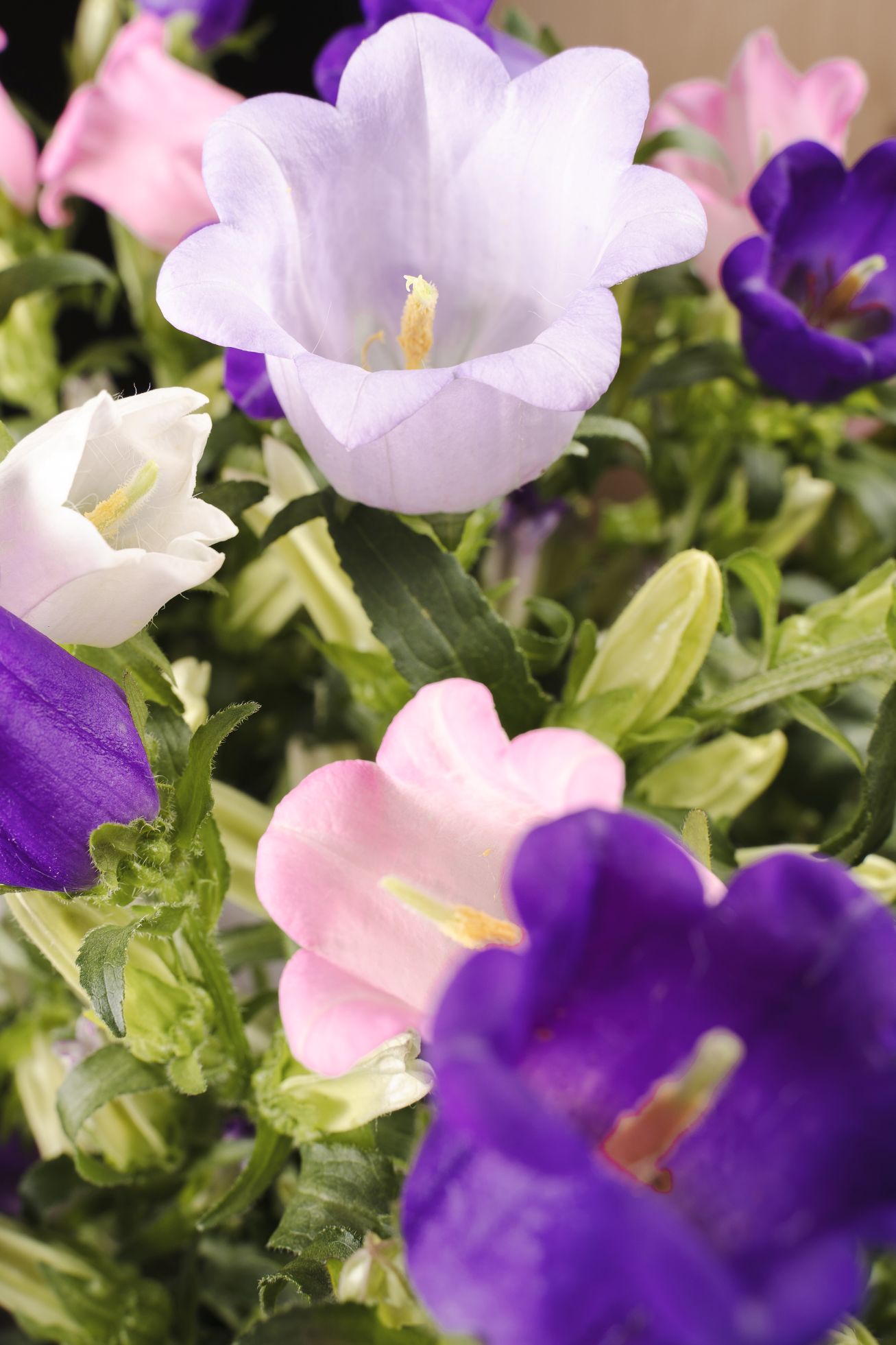




Campanula
Little church bells on a long stem: that is what a bunch of Campanula looks like. Her name comes from the Latin word campana, which means bell. In English, this cut flower is also known as Canterbury bells or bellflower. Botanically, it is Campanula medium, a species from the bellflower family (Campanulaceae). She originally comes from Southern Europe. The bells come in white, pink, lavender and blue.
Thanks to her airy shape, Campanula fits nicely into a loose, garden-style arrangement. Yet just a few stems in a vase already make a beautiful whole. Campanula ‘Champion’ is grown in six colours, all year round. From young cutting to mature stem, cultivation takes about seven to nine weeks, depending on the season. This bellflower comes from Tuil, from grower De Waal Tuil.
Did you know..
Canterbury bells were already recorded on paper more than four centuries ago. In 1604, engraver Crispijn van de Passe made a print of the flower. A hand-coloured copy of it is kept in an album from 1640, with plates from the herbarium of Anselmus de Boodt. That album is part of a series of twelve, made on the orders of Emperor Rudolf II. Today you can simply view the print online in the collection of the Rijksmuseum.
Campanula care
In the vase, Campanula does not ask for much, but she is very thirsty. With a few simple routines, she stays beautiful for as long as possible. The care tips in short:
- Cut the stems at an angle with a sharp knife and remove any leaves that would end up under water.
- Use a clean vase with cool water and cut flower food.
- Check the water level every day, because this bellflower drinks a lot.
- Please note: it is not known whether Campanula is toxic. Keep the vase out of reach of children and pets.
Campanula care tips
How do you cut the stem of a Campanula?
Your Campanula absorbs water best through a fresh, clean cut. So cut the stems at an angle with a sharp knife, about 2.5 to 5 centimetres from the bottom. A knife gives you a clean wound, so water can easily enter the stem. A ragged wound, on the other hand, attracts bacteria. Recut her stems every two to three days, at the same time as you refresh the vase water.
Should you remove the leaves of Canterbury bells?
With Canterbury bells, you remove all the leaves that would end up below the waterline. Florists often strip a third to half of the stem. The leaves above the water can simply stay on.
How much water does a Campanula need in the vase?
The bellflower is a real drinker. According to flower care experts, she can absorb up to 1.4 litres of water per day. So check the water level every day and top up in time. Use cool water, not softened water. Softened water contains salt, and that is bad for cut flowers.
Does a Campanula need cut flower food?
Campanula ‘Champion’ stays at her best in the vase with cut flower food in the water. A sachet like this contains sugars and chlorine, among other things. Dissolve it in cool water and follow the dosage on the packaging. Do you refresh the water every few days? Then add fresh flower food as well.
Where is the best place for a vase of Campanula?
Your Canterbury bells prefer a cool spot out of bright sunlight. Do not place the vase in a draught or next to a radiator. At a lower temperature, a cut flower ages more slowly. Also keep her away from the fruit bowl. Ripening fruit releases ethylene gas, and Campanula is sensitive to it. How strongly she reacts does vary per variety.
Can you use Campanula in floral foam?
For the bellflower, a vase with water works better than floral foam. She drinks a lot, and in floral foam she usually lasts less long. Always start with a clean vase. Do not use a metal or galvanised container unless it has an inner liner. Her long stems look lovely in a tall vase. In a mixed bouquet she makes an elegant line flower, but just a few stems on their own are enough too.
Is Campanula toxic to humans and animals?
The bellflower is not known to be toxic, but there is also no proof that she is safe. So far, no cases of poisoning by bellflowers are known. Still, eating any plant material can cause vomiting or stomach problems in dogs and cats. So it is best to keep your Campanula out of reach of children and pets. Has your pet eaten some of the flowers and does it show symptoms? Then call your vet.
Visible characteristics of the Campanula
Is your Campanula not doing what you expected? Unfortunately, that can happen! We’ve listed the most common visual characteristics below:
Why is my Campanula drooping?
If your Canterbury bells are drooping, they are usually not getting enough water. She drinks a lot, so the water level drops quickly. Bacteria in the water can also clog the vessels in the stem. As a result, she cannot drink as well. Top up the vase straight away, recut the stems at an angle and place her in clean water with fresh flower food.
Why are the flowers of my Campanula turning brown?
Brown, shrivelled bells on Canterbury bells often point to ethylene damage. This gas is released by ripening fruit, cigarette smoke and dying flowers, among other things. So do not place the vase near the fruit bowl. Remove wilted bells and old flowers in time.
Why are the buds of my Campanula not opening?
If the buds of your bellflower stay closed, ethylene may be the cause. Flowers that were harvested too early or kept cool for too long sometimes no longer open either. So preferably buy a bunch with some of the buds already open. Florists aim for roughly half open and half closed.
What are the grey spots on my Campanula?
Grey, fluffy spots on Campanula ‘Champion’ point to grey mould, also known as Botrytis. Campanula is sensitive to it. The mould starts with small brown spots, on which grey fluff later grows. It mainly strikes at high humidity, through small wounds or fallen florets. Remove affected and fallen flowers. Also make sure you do not spill water on the flowers.
Why is my Campanula getting yellow leaves?
When a bellflower has yellow leaves, ethylene may play a role. Yellow leaves, together with limp petals and dropping buds, are among the well-known signs of this damage. So take a good look at where the vase is standing. Ripening fruit, smoke or a bunch of old flowers nearby can be the cause.
Vase life of Campanula
How long a Campanula stays beautiful depends on the variety and on the care. The Champion series can have a vase life of up to 2 weeks. Refresh the water in time and recut the stems regularly. That way you get the most out of your bunch of bellflowers. Refresh the water in time and recut the stems regularly. That way you get the most out of your bunch of bellflowers.